Build an operating system for work that should move itself.
Armani maps the process first, then combines deterministic automation, grounded AI, integrations, agents, human approvals, and observability into a system your team can actually operate.
The right automation boundary changes by industry.
A good system does not automate everything it can. It automates the repeatable work, uses AI where interpretation helps, and protects the decisions that should remain accountable to experienced people.
Home services
Speed and completeness matter, but pricing, field diagnosis, scope commitments, and safety decisions need experienced people.
Lead capture + CRM creation
Missed-call / form acknowledgements
Appointment and estimate reminders
Review-request workflows
Routine status notifications
Lead-intent classification
Intake summaries for estimators
Photo / request description extraction
Estimate follow-up drafting
Service-area routing
Final pricing and scope
Field diagnosis and safety decisions
Change-order negotiation
Customer disputes
Contract commitments
What operating model does this process actually deserve?
Describe the workflow, its data, and the consequence of getting it wrong. The assessment is deterministic—no AI call is required to get a recommendation.
AI-assisted workflow
Routing, record updates, reminders, and other explicit repeatable logic.
Interpret language, classify context, retrieve knowledge, or draft bounded recommendations.
Approve consequential decisions, exceptions, and any action outside the defined policy.
Define acceptance tests and the human approval boundary before production.
Daily workflow: enough repetition to justify a focused pilot if the baseline can be measured.
From messy workflow to controlled production system.
We do not begin with a model or a chatbot. We begin by understanding the operating process, then move through explicit gates so the implementation earns its way into production.
Operational discovery
We map how the process actually runs today—not only the documented version. That includes inputs, handoffs, workarounds, exceptions, delays, system owners, and the consequence of a wrong result.
Process interviews and workflow observation
Current-system and data-source inventory
Exception and failure-mode capture
Baseline time / volume / response metrics
Current-state workflow map
System + data inventory
Exception register
Baseline operating metrics
The model is only one layer.
Reliable implementation depends on orchestration, data, permissions, deterministic logic, tool access, human approval, monitoring, and a rollback path. The AI model sits inside that system—it is not the system.
Website · chat · form · email · internal UI
Events · queues · routing · state · retries
Deterministic rules + retrieval + bounded model reasoning
CRM · database · approved documents · account context
APIs · calendars · notifications · approved tools · writes
Permissions · human gates · budgets · logs · evaluation · rollback
Different jobs require different orchestration.
Switch between common implementation patterns. Notice how a support assistant, a lead workflow, an internal knowledge system, and an agent place AI, rules, tools, and humans in different positions.
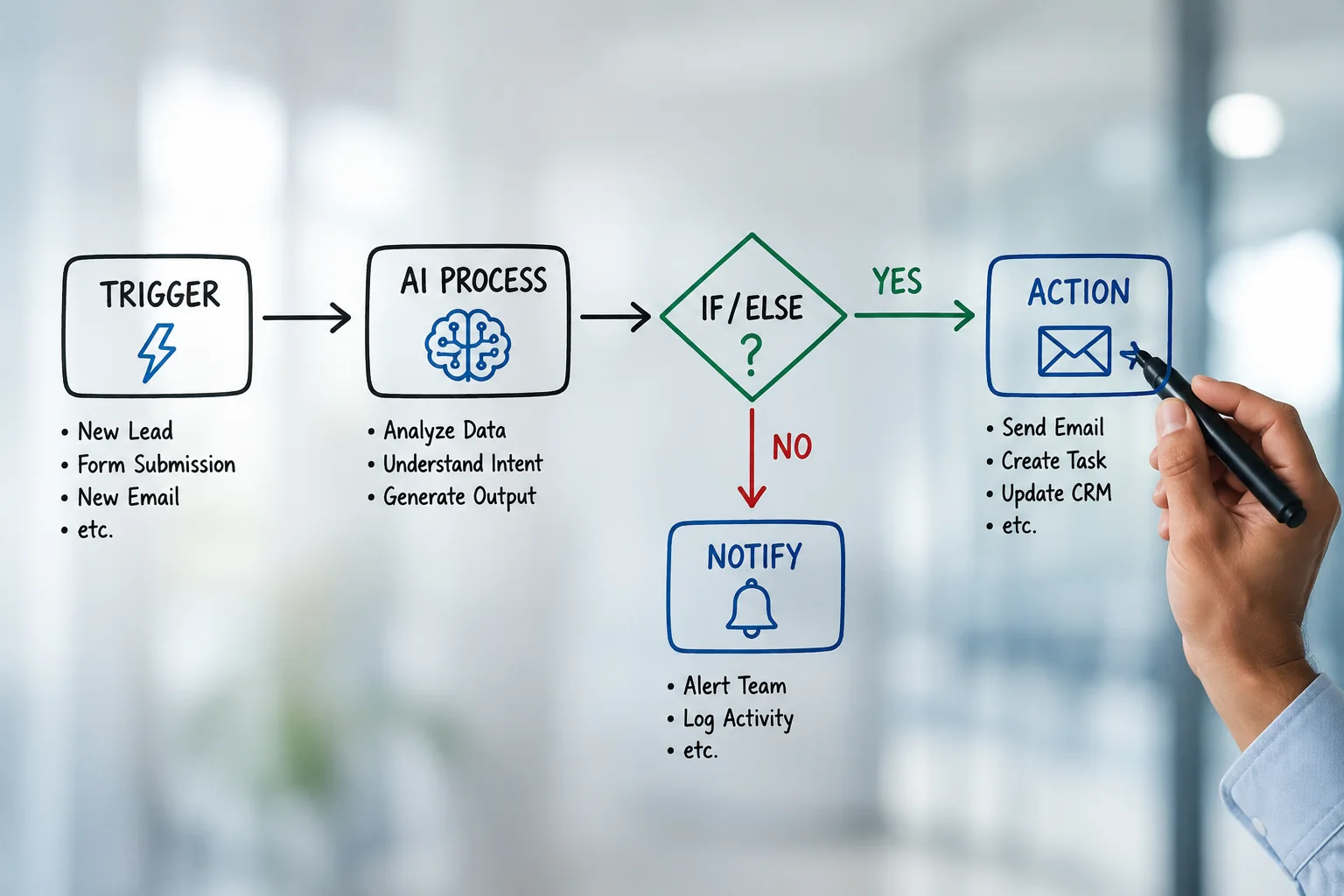
A lead arrives. The system decides what should happen next.
Collect context, classify intent, apply qualification rules, update the CRM, and move qualified opportunities toward a human conversation without forcing every lead through the same sequence.
We use the same architecture patterns internally.
Open the systems below and inspect where AI is allowed to reason, where deterministic logic remains authoritative, what happens when something fails, and which data crosses each boundary.


Website Launch Studio
AI proposes strategy inside a strict schema; Armani-owned components and deterministic QA decide what is allowed to reach the prospect.
Structured output only
One repair attempt maximum
Deterministic fallback strategy
Private first-party asset storage
Shared request / spend limits
Know what you are buying—and how we will know whether it worked.
AI implementation should have a clear entry point, an explicit decision at the end of each phase, and operating measures defined before production. Armani does not use an impressive demo as the success metric.
Workflow & AI Opportunity Audit
Teams that know repetitive work is costing time but have not yet defined the right automation boundary.
Map the current process and exceptions
Classify rules vs AI vs human judgment
Inventory systems, data, permissions, and failure consequence
Prioritize the first implementation candidate
Current-state workflow map
Automation opportunity matrix
Human-boundary recommendation
Pilot architecture + success criteria
Define success before the system earns more autonomy.
No fabricated ROI projection. Establish the baseline, instrument the workflow, then compare the same operating measures after deployment.
Timestamp intake, routing, qualification, handoff, and resulting sales stage changes.
What should a business know before deploying AI?
The questions that matter are about process ownership, data, permissions, failure behavior, human accountability, and measurable outcomes—not just which model is newest.
What kinds of AI systems can Armani implement?
Depending on the workflow, Armani can build grounded website or internal assistants, lead-qualification systems, workflow automations, knowledge retrieval tools, bounded agents, CRM and database integrations, intake systems, operational dashboards, and custom AI-enabled internal tools.
How do you decide what should be automated?
We map the current process and classify each step by predictability, ambiguity, risk, volume, reversibility, and need for human judgment. Repeatable rules stay deterministic, language or context-heavy steps may use AI, and consequential or novel decisions retain human ownership.
Do you replace existing software?
Usually not. We start by understanding the CRM, calendar, database, forms, email, documentation, and other tools already in use, then determine whether they can be connected into a coherent workflow before recommending replacement.
What is a trained or grounded chatbot?
For most business use cases, the goal is not to train a new foundation model. It is to ground an assistant in approved business knowledge, define what it may answer or do, require retrieval or citations where useful, and route uncertainty or restricted topics to a person.
What is an AI agent?
An agent is a system that can work toward a bounded objective across multiple steps and approved tools. Production agents should have explicit permissions, validation, stop conditions, observability, and human escalation rather than unrestricted access.
How do you test an AI implementation before launch?
We test representative normal requests plus missing information, ambiguous inputs, edge cases, provider and integration failures, permission boundaries, hallucination pressure, and human handoffs. Production deployment follows only after the intended failure behavior is understood.
Should AI be allowed to make decisions automatically?
Sometimes, but autonomy should match consequence and confidence. Low-risk reversible actions can often run automatically; high-impact decisions, exceptions, financial commitments, clinical or professional judgment, and uncertain cases should retain meaningful human oversight.
What happens after deployment?
We monitor outcomes, errors, costs, escalation behavior, and changing business requirements. The workflow can then be tuned, expanded, redesigned, or retired based on evidence rather than being treated as a set-and-forget installation.
How can a business start working with Armani on AI?
The right starting point depends on how clearly the workflow is already defined. Some teams need an opportunity audit first; others are ready for a controlled pilot or production implementation. Each phase should end with an explicit go, revise, preserve-human, or stop decision.
How do you measure whether an AI implementation worked?
We define the operating baseline and success measures before production. Depending on the workflow, that may include response time, manual touches, exception rate, escalation rate, task completion, corrections, cost per completed task, or resulting sales and service outcomes.